

A container of Ivorian cocoa powder is blocked at the Port of Antwerp. The problem isn't quality, price, or a customs declaration error. The problem is a missing set of GPS coordinates in the due diligence statement. The importer can trace the lot back to the cooperative, but not to the individual smallholdings that contributed to the batch. The shipment is declared non-compliant. Production schedules are threatened, and the commercial relationship is damaged. This is the new, brutally specific reality for food companies under the EU Deforestation Regulation (EUDR), and it represents a data-driven challenge that most supply chains were never designed to handle.
This Isn't Another Checkbox Exercise
For years, supply chain due diligence has been a matter of commercial traceability — knowing your tier-one supplier and perhaps their primary sources. The EUDR renders that model obsolete. By requiring operators to prove that commodities like coffee, cocoa, soy, and palm oil are not grown on land deforested after 31 December 2020, the regulation forces a level of transparency that is entirely new. The core of the law isn't a certificate or a supplier questionnaire; it is a mandatory due diligence statement containing the precise geolocation data for every plot of land where the raw material was grown.
This is not a suggestion. It is a precondition for market access. Failure to provide this data means goods are blocked. The penalties for non-compliance are severe, including fines of up to 4% of a company's total annual turnover in the EU, confiscation of the non-compliant product and any revenue derived from it, and temporary exclusion from public procurement. This elevates supply chain mapping from a corporate social responsibility initiative to a board-level operational and financial risk.
The ‘Plot of Land’ Is the Entire Problem
The regulation is explicit. For any plot of land over four hectares, the due diligence statement must include a polygon — a series of GPS points defining the plot's perimeter. For smaller plots, a single GPS point is sufficient. This sounds simple. It is anything but.
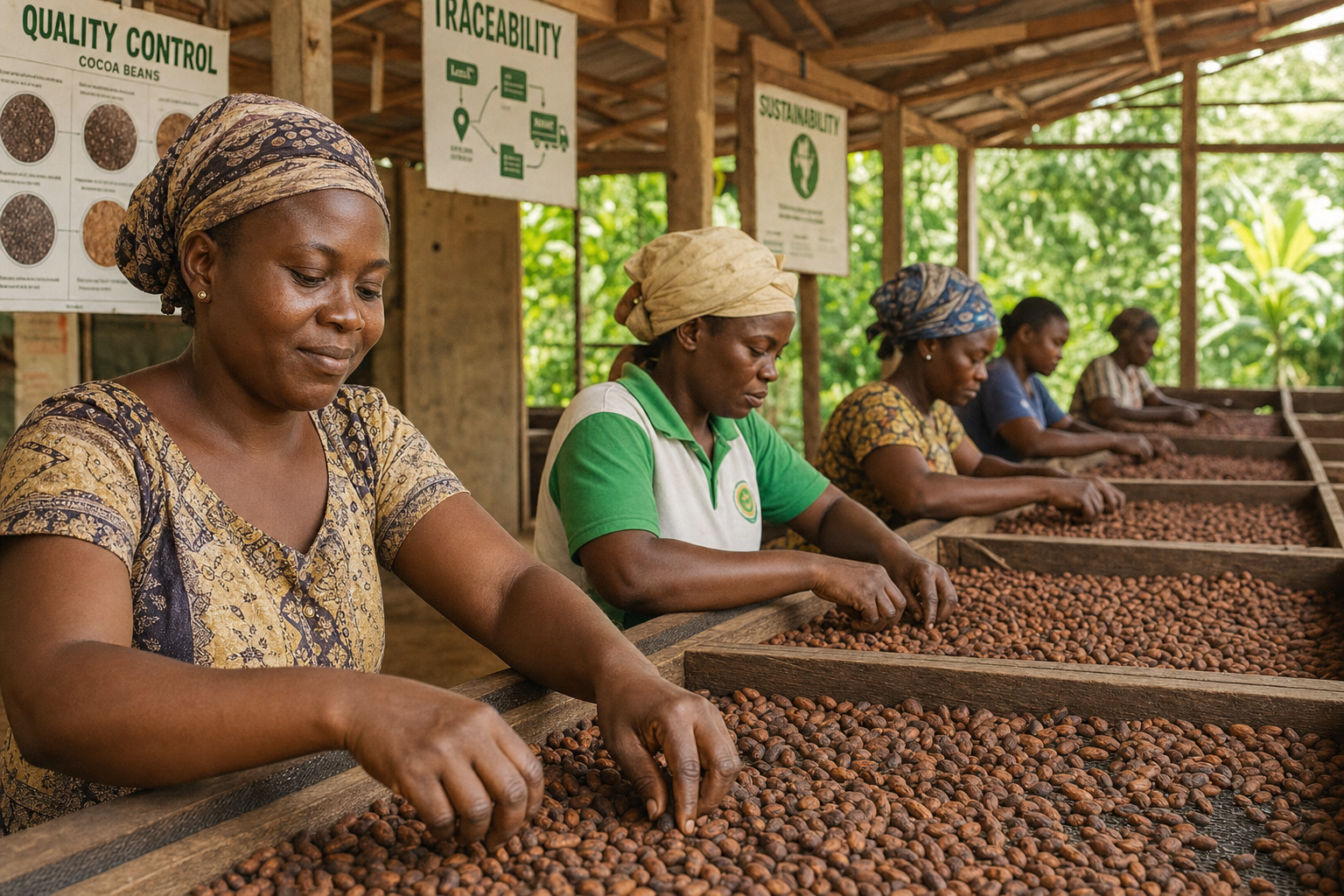
Consider the structure of the global cocoa supply chain. An estimated 90% of the world's cocoa is produced by 5-6 million smallholder households, mostly on plots of land smaller than five hectares. These beans are often sold to local intermediaries, mixed with beans from hundreds of other small farms at the cooperative level, and then sold on to exporters and processors. The trail from a specific 2-hectare farm to a specific 25-tonne batch of cocoa liquor has, until now, rarely existed. The beans are fungible; the batches are blended.
The EUDR demands that companies un-blend this reality. It requires them to connect a specific production batch inside their factory back to a collection of specific GPS coordinates in, for example, Ghana or Indonesia. This requires a digital chain of custody that most of the industry lacks. It involves equipping farmers or co-ops with GPS tools, training them, and creating a system to validate and link that spatial data to physical product movements. For many food companies, this is a capability they must build from scratch, often thousands of miles from their own operations.
Data Integrity Is the New Frontier
Collecting a list of GPS coordinates is only the first step. The real operational challenge is ensuring that the data is inextricably linked to the physical goods. How do you prove that the specific lot of soy flour in your warehouse (Lot #78B4) corresponds to the geolocation data submitted in your due diligence statement? A spreadsheet of farm locations is useless without a verifiable link to the inventory sitting on your racks.
This is where the architecture of your internal systems becomes critical. A modern inventory management system that uses lot attributes to capture not just expiry dates but also country of origin and, now, geolocation reference numbers, is essential. The system must maintain a full genealogy, tracing raw material lots through work orders into finished-goods lots. When a customs authority asks for the provenance of a specific pallet of finished goods, the answer must be retrievable in minutes, not weeks of forensic accounting through paper records and emails.
According to Fairtrade, around 80% of land in Ghana is under customary ownership and largely undocumented. In Côte d'Ivoire, only about 4% of rural land is covered by a formal certificate or title. The EUDR's demand for precise, documented plots of land runs directly counter to the on-the-ground reality of land tenure for millions of smallholder farmers.
A Forced Upgrade for Supply Chain Systems
The EUDR effectively legislates an end to siloed data. A company cannot comply if its purchasing system is disconnected from its inventory and production records. The purchase order for a batch of coffee beans must be linked to the supplier's due diligence statement reference. That reference must follow the beans as they are received into the warehouse, consumed by a food production work order, and packaged into a finished product.
This requires a single source of truth. When the purchasing, inventory, manufacturing, and compliance modules all operate on one unified data model, the digital thread is maintained automatically. A platform-based approach makes this traceability an intrinsic property of the system, not a painful reconciliation project performed after the fact. The lot record in the warehouse is the same record the quality team inspects and the finance team costs. Adding a geolocation reference to that one record makes it visible everywhere, instantly.
The Risk Has Shifted from Reputational to Operational
For years, the risk associated with deforestation was primarily reputational. Now, it is operational and immediate. A missing polygon in a GeoJSON file can halt a shipment, shut down a production line, and lead to a direct and quantifiable financial loss. The cost of compliance — investing in supplier engagement, technology, and data validation — is significant. But as of 30 December 2026, when the rules apply to all medium and large operators, the cost of non-compliance is catastrophic.
This shifts the conversation in the C-suite. Supply chain mapping is no longer a “nice to have” for the annual ESG report. It is a fundamental component of business continuity and market access. The CFO must now be as concerned with the quality of supplier GPS data as they are with currency hedging, because both can have a material impact on the bottom line.
The Unresolved Tension
While technology provides the tools for compliance, the EUDR surfaces a deeper, more uncomfortable tension. The regulation places the burden of proof on the importer, who in turn pushes it down the supply chain to traders, cooperatives, and ultimately, the smallholder farmer. There is a real risk that companies will de-risk their supply chains by favouring larger, industrialised farms that can easily provide the required data, potentially excluding the very smallholders who are most vulnerable. The law, designed to protect forests, may inadvertently penalise the people living closest to them. The most difficult part of this regulation is not found in a database, but in the complex human reality of the global food system.
Food Regulatory by Response365
The EUDR is a data problem before it's a compliance problem. Response365's Food Regulatory module, built on the same unified platform as our Inventory, Purchasing, and Manufacturing tools, provides the end-to-end traceability required to meet the challenge. Link geolocation data to supplier records and incoming lots, maintain a full digital genealogy from farm to finished good, and generate audit-ready reports without reconciling spreadsheets.