

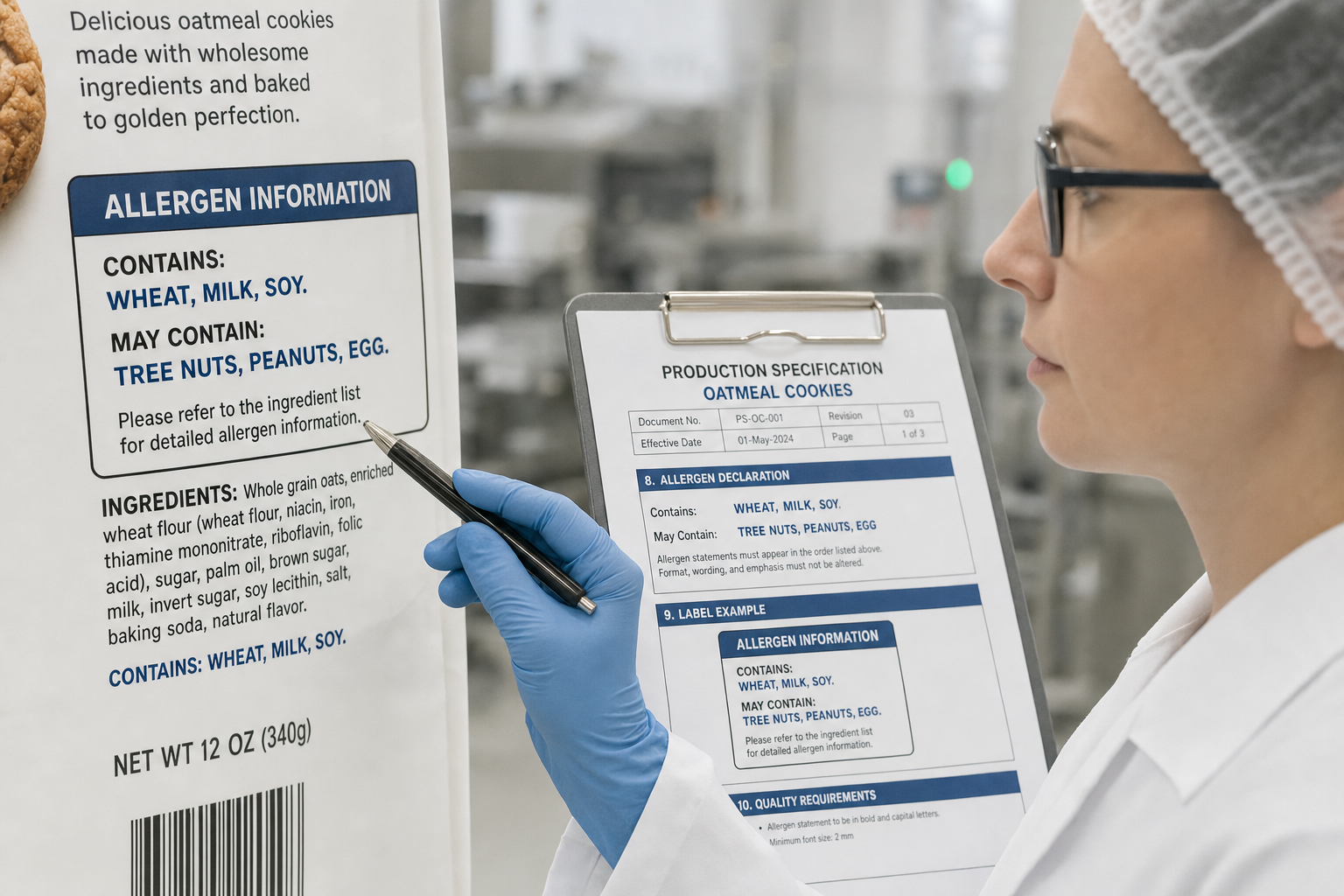
A pallet of vegan chocolate bars sits in a Belgian warehouse, already condemned. The problem wasn't the recipe, the ingredients, or a failure in food safety on the line. It was a single line of text missing from the label: 'May contain traces of milk'. The cost of this recall will run into the tens of thousands, accounting for logistics, disposal, and lost sales. The damage to the brand, which built its identity on being plant-based, is harder to calculate. This scenario, in countless variations, is playing out across Europe with punishing regularity.
The Known Unknown
Undeclared allergens are consistently the leading cause of food recalls in the EU. Depending on the year and jurisdiction, they account for somewhere between 30% and 40% of all food recall events. Data from the UK's Food Standards Agency showed that 57.6% of all their food recalls were allergen-related, with milk being the most frequent culprit. This isn't a case of exotic, unexpected contaminants appearing from nowhere. It is almost always one of the 14 major allergens specified in EU Regulation 1169/2011 — substances like milk, soy, nuts, and gluten that are the daily bread and butter of the food industry.
The failure is not one of food science. It is one of information management.
The allergen was known. It was in the recipe database. It was on the supplier's specification sheet. It was understood by the quality team. But between that knowledge and the printed label that gets wrapped around the final product, something broke. A process failed. A data silo prevented critical information from reaching the factory floor. An operator picked the wrong roll of packaging from a mislabelled rack. A last-minute ingredient substitution from purchasing was not communicated to the labelling team. These are not acts of God; they are operational gaps.
Spreadsheets Don't Scale. Nor Do They Talk.
For too many mid-sized food manufacturers, the information chain is a patchwork of disconnected systems. Recipe development happens in one application. The bill of materials (BOM) lives in the ERP. Supplier specifications are PDFs in a shared drive. Label designs are managed by the marketing team in a separate graphics program. Production schedules are on a spreadsheet. There is no single source of truth, only a series of data handoffs between departments and software that do not speak the same language.
Every handoff is a risk. Every manual data entry is a potential recall. A recipe is tweaked, adding a new sub-ingredient containing soy. Does this information automatically flag the relevant product labels for an update? In a disconnected environment, it relies on someone remembering to send an email. When the pressure is on to meet a production deadline, that is the step that gets missed. This is how a product that is perfectly safe to eat ends up becoming a Class I recall risk.
The Ripple Effect of a Single Recall
The direct costs of a recall are painful enough. The Grocery Manufacturer's Association has estimated the average direct cost at around €10 million, covering logistics, product destruction, and customer refunds. But that is merely the entry fee. The indirect costs spiral outwards, often causing far greater damage.
Consider the operational cascade:
- Investigation: Hours of management and quality team time are consumed tracing the failure's origin. Production lines may be halted.
- Customer Service: The support team is inundated with calls and emails, pulling them away from all other tasks. Every ticket needs to be logged against the recall event for regulatory purposes.
- Reputation Damage: Studies have shown that a significant percentage of consumers will avoid a brand for months, or even permanently, after a recall. In the age of social media, the damage is amplified instantly.
- Regulatory Scrutiny: A recall invites deeper inspection from authorities, potentially leading to fines and mandated changes in process that carry their own costs.
- Retailer Relations: Supermarkets and distributors lose confidence. They may demand additional guarantees, change payment terms, or delist the product entirely.
When you map this out, you realise you are not just managing a product recall. You are managing a full-blown business crisis, one that stresses every single department from finance to sales.
The most common source of recalls isn't a manufacturing failure. It was a documentation and labeling failure — the kind that happens after the product has been made correctly, and before it gets to the shelf. That's a very specific, very solvable problem.
Version Control Is Not Just for Software
The core of the problem lies in a failure to manage change. A food manufacturer's data is not static. Suppliers reformulate ingredients. Recipes are updated to improve cost or flavour. Packaging is redesigned. Each of these changes carries a potential allergen impact. The only way to manage this is with a unified system where a change in one place propagates everywhere it needs to.
This requires a single platform where the recipe, the batch record, inventory, and the label are not separate entities but different views of the same underlying data. When a food technologist in R&D versions a recipe in the food production software, the system should automatically know which labels are affected. The anachronistic process of sending a PDF of the new recipe to the packaging department and hoping for the best is a recipe for disaster. The label design tool must be bound to the live recipe data, automatically bolding allergens as required by law and flagging any design that uses an outdated ingredient list.
The Audit Trail Is the Defence
When the regulator calls following a recall, their first request is simple: show us your records. They want to see the full genealogy of the product. Which supplier lot of raw material went into which production batch? What were the quality checks on the line? Who signed off on the line clearance before this run began? Which version of the label was applied to this specific batch? For a business running on paper or spreadsheets, this is a frantic scramble through filing cabinets and disparate files, taking days or weeks to assemble a coherent picture.
An integrated platform with electronic batch records provides this audit trail instantly. Every scan, every operator signature, every quality check is recorded in an immutable, timestamped log. A one-click trace can show the entire journey from a specific customer shipment back to the individual raw material lots it contains. This is not just about compliance; it is about control. It is the difference between a swift, targeted recall of a few hundred cases and a catastrophic withdrawal of an entire season's production because you cannot prove where the problem started and ended.
Connection, Not Just Correction
For years, the industry has focused on data accuracy. We check, double-check, and triple-check supplier specifications. We audit our lines. We train our staff. These are all necessary actions, but they are clearly not sufficient. The persistence of allergen recalls proves that accuracy in a silo is a false security.
The challenge for the next decade is not data accuracy, but data connectivity. An accurate recipe that doesn't automatically inform the label is just as dangerous as an incorrect one. The question operations and finance leaders should be asking is not 'Is our data right?' but 'Is our data linked?'.
Food Production on Response365
Response365's Food Production module connects recipe management, electronic batch records, and label design in a single, unified database. When a recipe's allergen profile changes, the system automatically flags the corresponding label templates for mandatory review and update. Perform a complete, bidirectional recall trace in seconds, with an immutable audit trail that links every finished good back to its raw material lots and quality sign-offs.