

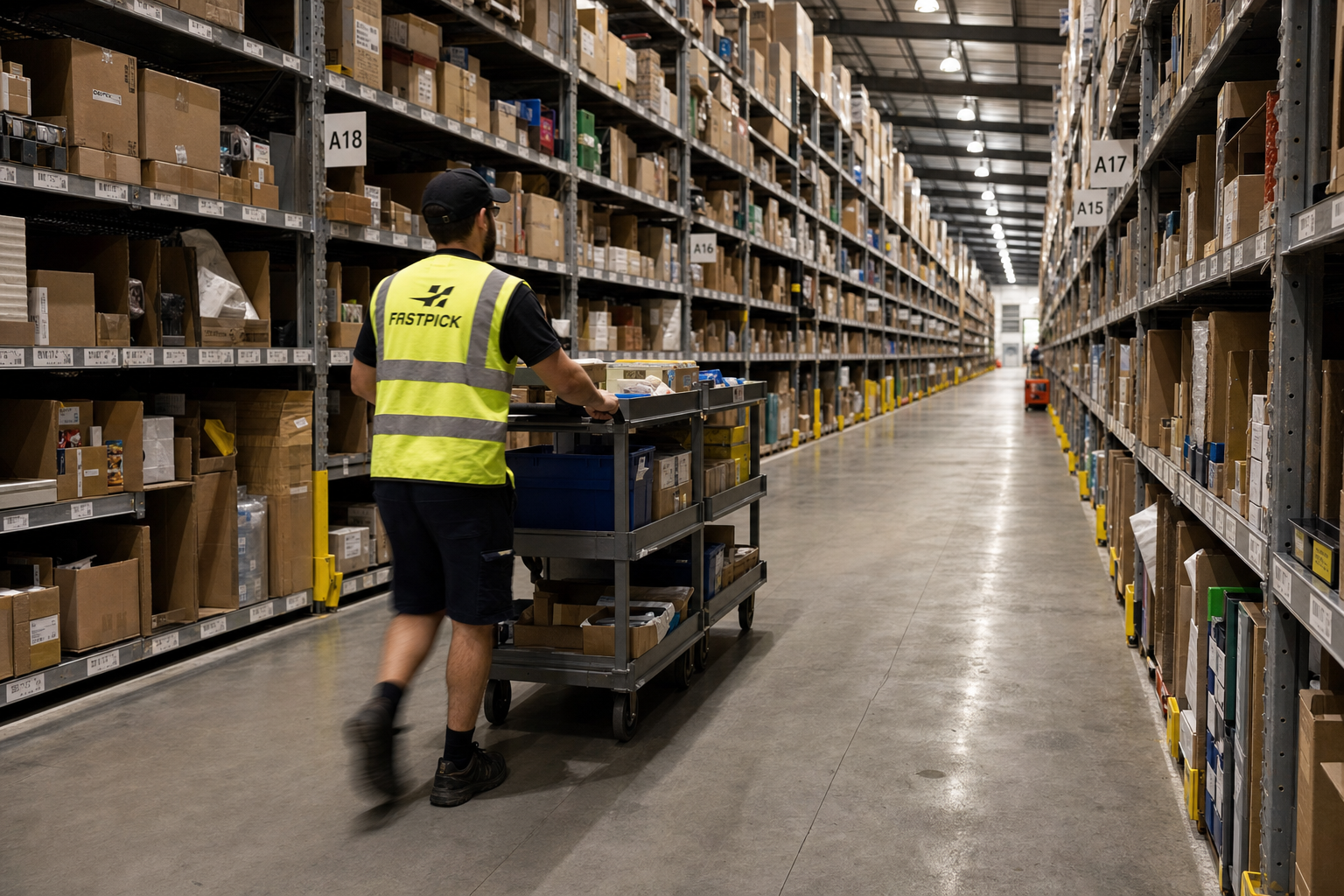
Watch a picker for an hour. Time how long they spend walking versus how long they spend actually picking an item off a shelf. Studies show that pickers can spend up to 70% of their time simply walking, not picking. That travel time, multiplied across dozens of pickers and thousands of shifts, represents a colossal operational cost hiding in plain sight. In many facilities, pickers walk as many as 12 miles (over 19 km) a day. This is not a labour problem. It is a geometry problem. And it is bleeding your operation dry.
The Anatomy of a Wasted Step
The 12-to-15-kilometre daily walk is not a sign of a hard-working team. It is a symptom of a dysfunctional system. The waste is embedded in the process itself. It is the empty travel to the first pick of a run. It is the backtracking from aisle D8 to C2 because the system sequenced the picks in an illogical order. It is the long walk to a half-empty pick face that should have been replenished hours ago.
Order picking is the most labour-intensive activity in the warehouse, accounting for as much as 65% of total operating costs. Every metre of unnecessary travel is a direct drain on your largest cost centre. This is not about making people walk faster; it is about making them walk less. Far less. The goal is to increase the density of value-adding work — the physical pick — and compress the non-value-adding travel that connects those picks.
Your Gut Feel is Wrong
Many experienced managers trust their gut, or the institutional knowledge of their veteran pickers, to know the “best” way around the warehouse. This is a fallacy. An experienced picker knows their zone, but they cannot possibly compute the optimal path for a wave of 50 different orders with 200 unique line items spread across 4,000 locations.
The human brain is not built to solve the Travelling Salesperson Problem on the fly, yet that is exactly what we ask pickers to do every minute of every shift. Without systemic support, they will default to what feels right: picking items in the order they appear on the list, or perhaps sweeping through aisles in a familiar but inefficient pattern. This individual, gut-feel approach creates congestion, inconsistent cycle times, and thousands of wasted kilometres per year. It mistakes activity for progress.
The Compounding Cost of Inefficiency
Let’s put this in financial terms. Labour typically accounts for 50-70% of a warehouse's operating budget. If half a picker’s 12 km daily walk is waste — 6 km of non-value-added travel — at an average walking speed of 4 km/h, that is 1.5 hours of paid time lost to inefficient routing. Every single shift.
For a single picker earning £15 per hour, that is £22.50 wasted per day. Across a team of 20 pickers working 250 days a year, that is £112,500 of annual payroll spent on nothing more than walking. And that is before we account for the downstream costs: increased fatigue, higher error rates, and the impact on order cycle times. A single mis-pick can cost anywhere from £15 to over £75 to resolve when you factor in returns processing, labour, and shipping. Tired, frustrated pickers navigating a chaotic path are more likely to make those costly errors.
Order picking activities account for approximately 55% of total warehouse operating expenses, making it a vital area for efficiency improvements.
Flawed Fixes and False Economies
Faced with this reality, many operators reach for the wrong tools. A common response is a complete physical re-layout of the warehouse. This is a high-disruption, high-cost project that treats a dynamic problem with a static solution. The layout might be optimal for today's order profile, but it will not be in six months when your sales mix changes.
Another common approach is to rely solely on a basic ABC analysis for slotting — putting the fastest-moving products nearest the packing stations. While better than nothing, this is a blunt instrument. It fails to account for items frequently ordered *together*, leading to pick paths that pinball across the warehouse to collect complementary products. A truly efficient system requires a more sophisticated approach, integrating sales data from your CRM and order history from your inventory management software into the routing logic.
System-Led Optimisation is the Only Answer
The only way to solve a complex routing problem is with a system designed for it. Modern Warehouse Management Systems (WMS) use algorithms to solve this puzzle in seconds, creating optimised pick paths that minimise travel distance for entire waves of orders, not just single picks.
Instead of a simple list, the picker’s scanner directs them on a logical, serpentine path through the aisles, ensuring every step is productive. The system batches orders intelligently, grouping those with items in close proximity. It understands the warehouse layout, one-way aisles, and congestion points. This is not about replacing the picker; it is about augmenting their skill with computational power they could never replicate on their own. This is precisely the function of the pick-path optimisation engine within the Response365 Warehouse Management module. By processing orders in waves, it calculates the most efficient route, turning a chaotic task into a directed, streamlined flow.
Beyond the Path: Slotting and Replenishment
An optimised pick path is only as effective as the inventory layout it navigates. This is where slotting optimisation becomes critical. A proper WMS does not just rely on a static ABC analysis. It uses velocity data to dynamically manage storage locations. Fast-moving products are not only kept near the front but are placed in the “golden zone” of picking (between waist and shoulder height) to reduce physical strain and increase speed.
Furthermore, the system must be connected to replenishment. The most efficient pick path in the world is worthless if the picker arrives at an empty location. An integrated system, like Response365, automatically triggers a replenishment task from bulk storage when a forward picking location dips below its statistically-set safety stock level. The pick is never held up by an avoidable stockout.
The Data is Already in Your Building
The most frustrating part of this enormous profit leak is that for most businesses, the data needed to plug it already exists. It is latent in your sales order history, your goods receipt notes, and your dispatch records. The problem is that it lives in disconnected systems — an ERP, a separate warehouse application, maybe even spreadsheets — that cannot talk to each other.
The solution is not another standalone tool. It is a unified platform where sales, inventory, and warehouse operations share a single data model. When your warehouse system knows not just what was ordered, but the profitability of that customer and the contractual SLA on that order, it can make smarter decisions. This is the fundamental difference a platform like Response365 makes. The intelligence is not siloed; it is systemic.
Warehouse Management
Stop wasting money on footsteps. Response365’s Warehouse Management module uses wave-based picking and pick-path optimisation to minimise travel time and maximise picks per hour. With integrated slotting optimisation and an automatic replenishment engine, it ensures your team is always on the most efficient path to the right product.