

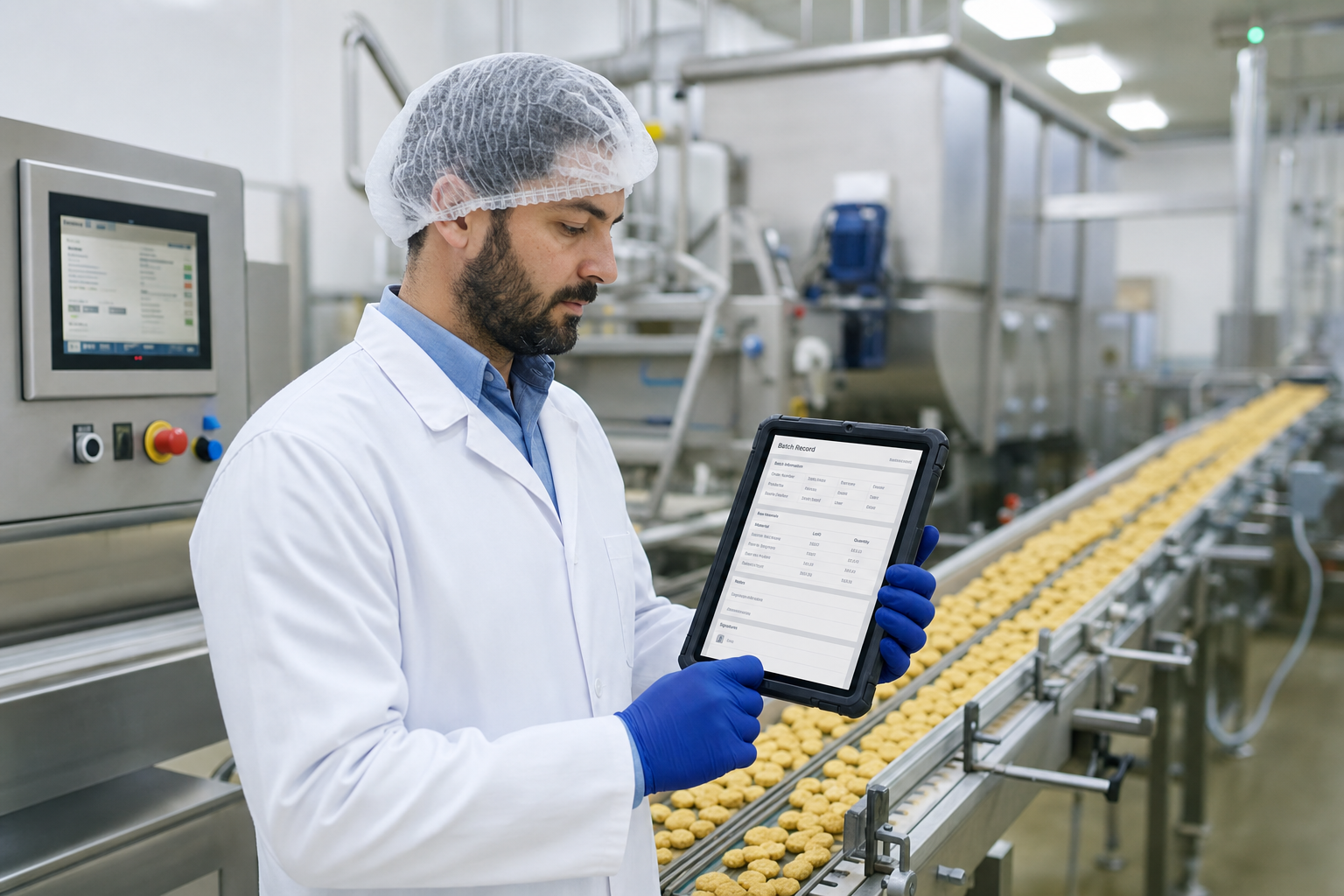
A food manufacturer receives a call from a retailer on a Tuesday afternoon: a customer has reported an allergic reaction to a product carrying a nut-free claim. The retailer needs to know, within hours, every lot number involved, every ingredient supplier, every production line the product touched, and every customer who received that batch. The manufacturer has the information. It is in three ring binders stored in a quality office, and it takes four people two days to compile it.
That scenario is not unusual. It is the standard experience of mid-market food manufacturers operating on paper-based batch documentation — and the gap between what the paper system can deliver and what regulators and retailers now require is widening every year.
What a Batch Record Is and Why It Matters
A batch record is the complete documented history of a production run: what ingredients were used and from which lots, which equipment was involved, which operators worked each step, what quality checks were performed and what they found, and what the final yield was. For food manufacturers operating under HACCP, EU Regulation 178/2002, or FDA 21 CFR Part 117, the batch record is the evidence that the food was produced safely and in accordance with the recipe and process specification.
It is also, in the event of a complaint, contamination incident, or recall, the document that determines how quickly and precisely the manufacturer can respond. A batch record that can be retrieved and interpreted in minutes leads to a targeted recall. One that requires days to assemble leads to a precautionary withdrawal of a far wider product range — which is more expensive, more damaging to retailer relationships, and harder to recover from reputationally.
The Paper Trail Problem
Paper batch records are not inherently wrong. The information they capture is the right information. The problems arise in how that information is recorded, stored, and retrieved.
Recording is the first failure point. Operators filling in paper forms at the end of a shift — rather than at the point of each action — introduce transcription errors, fill in estimated rather than actual values, and sometimes skip steps entirely when production is under pressure. There is no system to enforce that a CCP check was signed before the next operation proceeds. The form might require it, but the production line does not stop until it is done.
Storage is the second. Paper records are filed physically, scanned inconsistently, and frequently misfiled or lost during facility relocations, audits, and staff changes. The retention requirement under EU law is typically two years beyond the product's shelf life. For a product with a three-year shelf life, that means five years of paper records, retrievable by lot number, across product families that may have been reformulated multiple times.
Retrieval is the third, and the most operationally damaging. A backward traceability query — show me every finished lot that used ingredient lot X — requires manually searching potentially thousands of records. Forward traceability — show me every customer who received product from batch Y — requires cross-referencing batch records against despatch records that may be in a separate system. Neither exercise is feasible in the two-hour window that a serious food safety incident allows.
What Regulators and Retailers Are Actually Asking For
EU Regulation 178/2002 requires one-step-back, one-step-forward traceability. In practice, major retailer codes of practice — BRCGS, IFS, FSSC 22000 — require considerably more: full batch genealogy, CCP documentation with signed verification, and demonstrated recall capability tested at least annually. Certification auditors assess not just whether the records exist, but whether they can be produced on demand, in a format that supports traceability queries, with evidence that the data was captured at the time of production rather than reconstructed afterwards.
The question an auditor is really asking is not "do you have batch records?" It is "can you prove, from the records alone, that this batch was safe to release — and could you answer that question in two hours during a live incident?"
FDA FSMA Rule 204, which came into force for most manufacturers in 2026, goes further: it requires electronic, sortable records for certain high-risk foods, with the ability to produce traceability data within 24 hours of a request from a regulator. Paper records, however well organised, cannot satisfy that requirement.
FDA 21 CFR Part 11 and the E-Signature Standard
For manufacturers operating under FDA oversight — including those exporting to the US — 21 CFR Part 11 establishes the requirements for electronic records to carry the same legal weight as handwritten signatures. The standard is not simply "make it digital." It requires that electronic records be attributable to the individual who created them, that they cannot be altered without an audit trail of the change, and that signatures carry a defined meaning (not just a name, but what was being attested to).
This matters because the shift from paper to a simple digital form does not automatically satisfy Part 11. A PDF that operators fill in on a tablet and save locally is not compliant. An immutable, time-stamped record with an attributed e-signature that captures what the operator certified — "I verified that the CCP temperature was within specification at 14:32" — is.
The distinction has practical consequences for manufacturers who have digitised in form only. If a US recall investigation questions the integrity of production records, a signature on a PDF can be challenged. A Part 11-compliant record cannot.
The Allergen Control Dimension
Of all the reasons batch records matter, allergen control is the one that directly drives consumer safety outcomes. A batch record that documents which allergens were present in which ingredients, which production line the product ran on, and whether an allergen cleaning protocol was completed and verified before the run is the only documentary evidence that a nut-free claim, a gluten-free claim, or a dairy-free claim on a label can be defended.
Paper-based allergen records have a specific vulnerability: the cleaning verification step. If the protocol requires an operator to sign off that the line was cleaned to allergen-free status before the next allergen-incompatible run begins, the paper form captures that a signature was applied. It does not prevent the signature from being applied before the cleaning was complete. An electronic system that locks the next production step — preventing the batch from advancing until the CCP check is recorded — addresses this gap at the process level, not the documentation level.
Real-Time Records vs Retrospective Documentation
The most significant operational difference between paper and electronic batch records is when data is captured. Paper records, in practice, are largely retrospective: operators note what happened after the fact, at a natural break in production, or during a quiet period. Electronic records, when integrated with the production system, are captured at the point of action: the operator scans the ingredient lot, records the quantity used, photographs a quality check, and signs the CCP step before the next step is available.
The difference in data quality is substantial. Retrospective records carry the errors that come from memory: rounded numbers, missed deviations that seemed minor at the time, and steps that were actually skipped but recorded as completed. Point-of-action records carry what actually happened, with a timestamp that reflects when it happened.
For a manufacturer that has never experienced a serious recall, the distinction may seem academic. For one managing a live incident, it is the difference between being able to defend the batch record in front of a regulator and being unable to.
The Recall Simulation Test
The standard by which batch documentation should be evaluated is the mock recall: how long does it take, starting from a specific ingredient lot number, to identify every finished product lot that contained it, every customer to whom it was despatched, and the total quantity in the market? BRCGS and IFS require this exercise to be documented and typically expect completion within a defined window — often two to four hours.
Most manufacturers who run mock recalls on paper systems discover that the actual time significantly exceeds this window. The gap between the target and the actual is the risk exposure — not as a compliance statistic, but as the practical time window during which a contaminated product remains in the market while the scope of the recall is being determined.
Electronic batch records with built-in genealogy reduce this to a query. The same exercise that takes four hours on paper takes four minutes when the data was captured electronically and the traceability links were maintained in a single system throughout production.
Response365 Food Production: EBR Built Into Every Batch
Response365 Food Production includes Electronic Batch Records as a native module — template-driven, with operator e-signature per production step, photo and document capture, and an immutable audit trail that meets FDA 21 CFR Part 11 patterns. Allergen control is enforced at the line level, with cleaning protocol verification required before the next production step can proceed. Forward and backward traceability runs as a single query across the genealogy graph. Mock recall drills are schedulable, timed, and filed as evidence against certification records.