

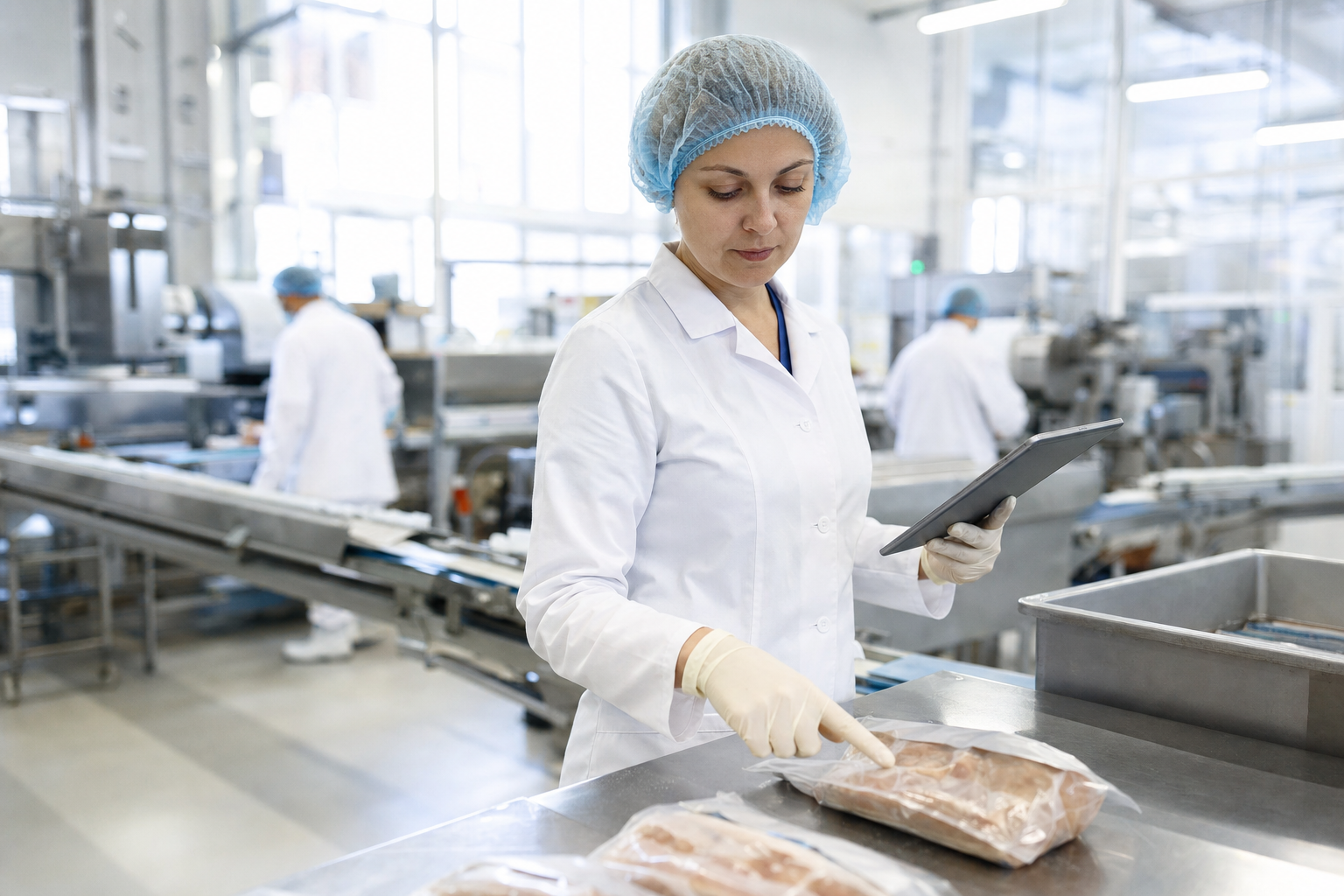
European food producers are facing a regulatory convergence that has no recent parallel. Three distinct legislative frameworks — each significant on its own — are arriving close enough together that the compliance burden multiplies rather than adds. For businesses still managing production records in spreadsheets, paper binders, or disconnected systems, the window to prepare is narrowing faster than most realise.
This article is not a legal guide. It is an operational one: what these regulations require in practice, where the gaps are in how most food businesses currently manage records, and what needs to change before the deadlines become penalties.
The Baseline: What EU Food Law Already Requires
Most food producers operating in the EU are familiar with Article 18 of Regulation 178/2002 — the General Food Law — which established the "one step back, one step forward" traceability principle. Businesses must be able to identify from whom they received a food product and to whom they supplied it. This has been the baseline for two decades.
What most businesses have not fully absorbed is that this baseline is now being used as the floor for a much taller structure. The regulatory additions of the past three years don't replace Article 18 — they build on it, requiring faster retrieval, more granular data, and in some cases machine-readable formats that a paper binder structurally cannot provide.
When a regulator or retailer asks for your traceability data today, you have 4 hours in some jurisdictions to respond. The businesses that can answer in 4 minutes rather than 4 hours are operating a different class of system.
Farm to Fork: The Ambition Behind the Compliance Requirements
The European Green Deal's Farm to Fork Strategy set targets that have direct operational consequences for food producers: 50% reduction in pesticide use, 20% reduction in fertiliser use, 25% of agricultural land under organic farming, and significant reductions in antimicrobial use in livestock — all by 2030.
What this means in practice for traceability is a shift from documenting what was produced to documenting how it was produced. A food producer selling into EU markets increasingly needs to be able to demonstrate that ingredients were sourced from farms that meet specific sustainability criteria — and that evidence must be documentable throughout the chain, not just asserted at the point of sale.
The "sustainable from farm to fork" claim that appears on packaging is becoming a regulated statement, not a marketing decision. The records needed to substantiate it are the same records a producer would need to respond to a traceability audit — which means the compliance investment in one area directly serves the other.
The EU Deforestation Regulation: A New Supply Chain Obligation
The EU Deforestation Regulation (EUDR), which entered into force in June 2023 and whose requirements apply to operators placing relevant commodities and products on the EU market, introduces an obligation that most food companies were not prepared for: demonstrating that products have not contributed to deforestation or forest degradation after December 31, 2020.
The commodities in scope — cattle, cocoa, coffee, palm oil, soya, wood, rubber, and derived products — cover a significant portion of the ingredient supply chains of European food manufacturers. The due diligence requirement is not just a supplier declaration. It requires geolocation data for the land where the commodity was produced, documentation that this land was not subject to deforestation, and evidence of compliance with the laws of the country of production.
This is categorically different from previous supply chain sustainability requirements. It requires data that flows from the farm level up through every tier of the supply chain to the EU operator. For businesses that currently lack visibility beyond their immediate suppliers, building that upstream data chain from scratch is a significant project.
Digital Product Passports: The Longer-Term Architecture
The EU's Ecodesign for Sustainable Products Regulation (ESPR) is introducing the Digital Product Passport (DPP) — a machine-readable record attached to a product that contains information about its components, materials, sustainability characteristics, and supply chain provenance. While the initial rollout focuses on batteries and textiles, the extension to food products is part of the European Commission's stated roadmap.
The DPP architecture requires data to be structured, standardised, and accessible via a unique product identifier — a QR code or similar. This is not a document you scan and upload. It is a database record that must be maintained, updated, and accessible throughout the product's lifecycle.
For food producers, this represents the end state toward which the current traceability regulations are building: every batch of product linked to a complete digital record of its origin, production process, ingredients, and environmental footprint, accessible to regulators, retailers, and consumers on demand.
Where Most Food Businesses Are Falling Short
The gap between where most food businesses currently operate and where regulation is taking them is large, and it is not primarily a technology gap. It is a data architecture gap.
The paper problem. Many food producers, particularly in the mid-market, still capture batch records, cleaning logs, temperature monitoring, and supplier documentation on paper or in disconnected Excel files. These records satisfy the letter of Article 18 for current audits. They do not satisfy the retrieval speed, format requirements, or upstream linkage requirements that newer regulations impose.
The silo problem. Even businesses that have moved to digital record-keeping often have their quality records in one system, their production data in another, their supplier records in a third, and their logistics documentation in a fourth. Linking a specific batch of finished product back through production steps to raw material batches to supplier farms to geolocation data requires joining all of these — a process that takes days when it needs to take hours.
The supplier depth problem. EUDR and Farm to Fork requirements do not stop at direct suppliers. They require traceability up through the supply chain to the point of primary production. Most food businesses have good visibility of Tier 1 suppliers and limited visibility of anything beyond. Building Tier 2 and Tier 3 visibility requires a different approach to supplier data collection than most businesses currently operate.
What Good Traceability Looks Like in Practice
For a mid-size food producer, the operational target is a system where any batch of finished product — identified by lot number or GS1 barcode — can be traced in minutes to:
- Every raw material batch that went into it, with supplier lot references
- The production steps it passed through, with timestamps, equipment identifiers, and operator records
- The quality checks performed and their results, including any deviations and corrective actions
- The storage and temperature history from production through dispatch
- The customers and delivery locations it was shipped to
- For EUDR-relevant ingredients: the geolocation and deforestation-free documentation from the upstream supply chain
This is not exotic technology. Batch management, production order tracking, and quality management systems that support this structure have existed for years. What has changed is the regulatory expectation that this level of traceability is standard, not premium — and the enforcement mechanisms being put in place to verify it.
Allergen Management: The Parallel Compliance Pressure
Alongside the sustainability and origin traceability requirements, allergen management continues to be one of the highest-risk compliance areas for food producers. EU Regulation 1169/2011 requires clear allergen labelling, but the labelling is only as reliable as the production records behind it.
The most common allergen contamination incidents — and associated recalls — involve failures at the production record level: wrong raw material batch used, cross-contamination from a previous production run not documented, recipe change not reflected in the labelling system. Each of these is a data linkage failure, not a production failure. When production records and labelling data live in different systems without enforced linkage, the risk of this kind of failure is structural rather than incidental.
The Practical Preparation Agenda
For food businesses assessing their position against the regulatory trajectory, four priorities stand out:
- Audit your current record retrieval time. If a regulator called today and asked for full batch traceability on a product dispatched six months ago, how long would it take? If the honest answer is "more than a day," that is the benchmark to improve against.
- Map your EUDR commodity exposure. Identify which of your ingredients fall within the EUDR commodity scope and assess how far upstream your current supplier data reaches. The gap between where your data ends and where the farm-level evidence needs to start is your project scope.
- Standardise your batch identification system. Lot traceability only works when batch identifiers are consistent across all systems — production, quality, warehouse, dispatch. If your batch numbers in the production record don't match the batch numbers on the shipping documentation, linking them requires manual reconciliation that breaks under pressure.
- Move supplier documentation into a system, not a folder. Supplier certificates, farm declarations, and deforestation-due-diligence documents stored in email folders or shared drives cannot be queried, cannot be linked to batch records, and cannot be retrieved at scale. They need to be in a system that connects them to the supply chain records they validate.
Food production traceability built for EU compliance
Response365 Food Production, Food Regulatory, and Food Trade modules are designed around batch-level traceability — connecting production records, supplier documentation, quality data, and dispatch records in a single system auditors can access in minutes, not days.