

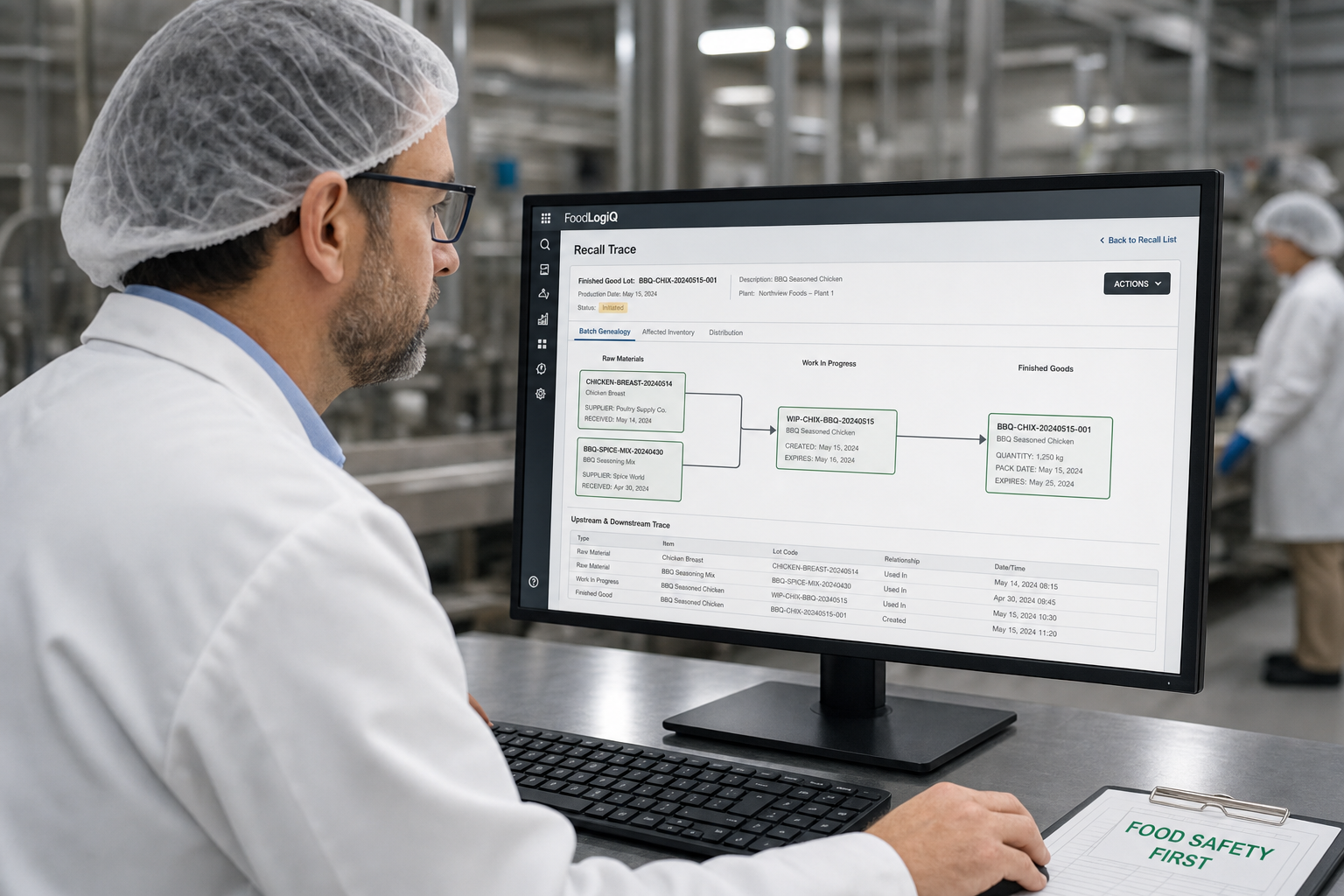
When a food safety incident occurs, the clock starts ticking. Regulators, customers, and supply chain partners all demand immediate answers. How quickly and accurately you can trace a compromised ingredient from its source, through your production process, and out to every affected customer is the ultimate test of your systems. For too many food businesses, this test reveals a critical, structural weakness: their data lives in silos. Production data sits in one system, inventory in a warehouse management system (WMS), purchasing records in another, and customer shipments in the core enterprise resource planning (ERP) system. This fragmentation is not just an operational headache; it is a direct and quantifiable risk. In a recall, the time spent manually reconciling these disparate datasets is time when unsafe products remain on shelves and consumer trust erodes.
The Anatomy of a Modern Food Recall
A recall is not a single action but a cascade of urgent, data-dependent tasks. It begins with identifying the specific batch or lot number in question. From there, the business must perform a two-way trace with absolute precision. The backward trace, or traceback, follows the ingredient's journey from the supplier, through goods-in, quality control, and into production. The forward trace follows the finished product from the factory floor, through the warehouse, onto delivery vehicles, and to every single business or consumer who received it. Every step must be documented and verifiable.
Regulatory pressure is intensifying this challenge. In the United States, the FDA's FSMA Rule 204 mandates that companies handling high-risk foods must provide detailed traceability records to regulators within 24 hours of a request. Similarly, the EU's General Food Law (Regulation 178/2002) requires all food business operators to implement a “one step forward, one step back” traceability system, enabling the rapid withdrawal of unsafe products. These regulations make it clear that slow, manual, spreadsheet-based traceability is no longer a viable option. The expectation is near-real-time data access.
The financial stakes are immense. The average direct cost of a food recall is estimated at $10 million, but this figure only covers expenses like product retrieval and disposal. When indirect costs such as lost sales, litigation, and long-term brand damage are factored in, the total impact can be catastrophic, with some recalls costing companies over $100 million. The speed of response is directly correlated to the final cost; the longer it takes to contain the incident, the higher the financial and reputational damage.
When Systems Don't Talk: The High Cost of Data Silos
The core problem in a slow recall is almost always data fragmentation. Consider a typical scenario: a quality issue is flagged with a specific lot of a finished good. To initiate a recall, the operations manager needs to connect information from at least four different systems:
- Production System: Which raw material lots were consumed in this finished good batch? What were the exact quantities and production times?
- Purchasing/Supplier System: Who was the supplier of that raw material? What was the purchase order number and delivery date?
- Warehouse Management System (WMS): Where is the remaining stock of the compromised raw material? Where are all the pallets of the affected finished good located?
- ERP/CRM System: Which customers received products from this specific lot? What were their sales order and invoice numbers?
In a siloed environment, answering these questions involves a frantic, manual effort. Staff must export data from each system, often into spreadsheets, and then attempt to stitch it together. This process is slow, prone to human error, and creates multiple, conflicting versions of the truth. While teams are busy chasing and reconciling data, the window for effective action closes. This operational friction is a hidden tax on the business, draining productivity and inflating risk.
The Power of a Single Data Model
The solution is not better integrations or more complex data warehouses; it is a fundamental shift in architecture. When ERP and food production systems share a single database and a unified data model, the entire concept of a data chase becomes obsolete. A "lot number" ceases to be a simple text field that needs to be matched across different tables. Instead, it becomes a single, shared record that is intrinsically linked to every related event and transaction across the business.
In a unified platform like Response365, this means the raw material lot received in the Purchasing module is the *exact same record* that is consumed by a work order in the Manufacturing module. The finished good lot created by that work order is the same record managed by the Inventory Management and Warehouse Management modules. And that, in turn, is the same lot record allocated to a sales order in the CRM and shipped to a customer. There is no syncing, no exporting, and no reconciling, because there is only one version of the data.
"Digital systems dramatically speed up and narrow recalls by replacing manual logs with real-time, centralized traceability, allowing companies to identify affected products in minutes instead of hours or days."
Tracing at the Speed of Data: Forward and Backward Genealogy
This single-database architecture transforms recall readiness from a reactive scramble into an instantaneous query. The concept of a product genealogy—the complete, end-to-end history of every component and process—is not something that has to be painstakingly constructed after an incident. It is built automatically, in real time, with every transaction.
Imagine a regulator requests a full trace on a specific finished good lot. With a unified system, an operator can execute this in a single click. The platform walks the genealogy graph instantly:
Backward Trace: From the finished lot number, the system immediately identifies the parent work order, the bill of materials version used, the exact raw material lots consumed (including quantities and timestamps), the supplier purchase orders for those lots, and the associated quality inspection results from the Food Production module.
Forward Trace: From the same lot number, the system identifies every pallet it was stored on, every stock movement within the warehouse, every sales order it was allocated to, every shipment it was part of, and the name and address of every end customer who received it.
This is not a theoretical capability; it is the practical outcome of having modules for Inventory Management, Manufacturing, and CRM all reading from and writing to the same append-only ledger. The entire history is immutable and instantly searchable, turning a multi-day forensic accounting project into a report that runs in seconds.
Beyond Traceability: Managing the Full Recall Workflow
A successful recall involves more than just identifying the affected product. It requires a coordinated, cross-functional response to contain the issue, manage communications, and handle the reverse logistics. A unified platform is uniquely positioned to manage this entire workflow because it connects every department involved.
Once the scope of the recall is identified, a series of actions can be triggered from a single command centre:
- Containment: The system places an immediate hold on all remaining inventory of the affected lots in the Inventory Management module, preventing any further shipments.
- Communication: A dynamic segment of all affected customers is automatically generated in the CRM. The Go-to-Market module can then be used to send targeted recall notifications via email and SMS, while the Customer Service module prepares for inbound inquiries, with every agent having a full view of which customers are affected.
- Recovery: Return orders can be generated in the E-Commerce and Logistics modules to manage the physical collection of the recalled product, with real-time tracking.
- Compliance: The Food Regulatory module's 5-stage recall workflow guides the team through every step, from identification to closure, ensuring all regulatory reporting requirements are met and documented in an immutable audit trail.
- Financials: The full financial impact, from the cost of scrapped inventory to the cost of reverse logistics, is automatically calculated and posted to the general ledger by the Profitability Monitor, providing the CFO with immediate visibility.
This level of coordinated response is impossible when each department is working from its own separate system. It is the shared database that allows for a single, seamless workflow that connects operations, sales, service, and finance.
From Reactive Response to Proactive Prevention
Ultimately, the best way to handle a recall is to prevent it from happening in the first place. A unified data platform provides the visibility needed to move from a reactive to a proactive food safety culture. When quality data is not isolated in a separate system, it can be used to inform real-time production decisions.
For example, within Response365's Food Production module, recipes have critical control points (CCPs) and quality checks embedded directly into the workflow. An operator must electronically sign off on these checks in the Electronic Batch Record (EBR) before proceeding to the next step. If a quality plan in the Manufacturing module detects an out-of-control signal via Statistical Process Control (SPC), an alert can be raised automatically, preventing a non-conforming batch from ever being completed.
Furthermore, the system enforces safety protocols programmatically. The Warehouse Management module can enforce strict allergen segregation and First-Expired-First-Out (FEFO) picking logic. The Food Production module's allergen mapping and cleaning verification protocols prevent cross-contamination between production runs. These are not just policies in a binder; they are rules enforced by the system on every transaction, because the system has a complete, end-to-end view of ingredients, recipes, and production lines—all from one database.
Food Production on Response365
Stop chasing data and start building a resilient, compliant food operation. The Response365 Food Production module, built on the same unified platform as our ERP, CRM, and WMS, gives you one-click forward-and-backward traceability, electronic batch records, and integrated quality management. Manage recalls in minutes, not days, and move from reactive crisis management to proactive prevention.