

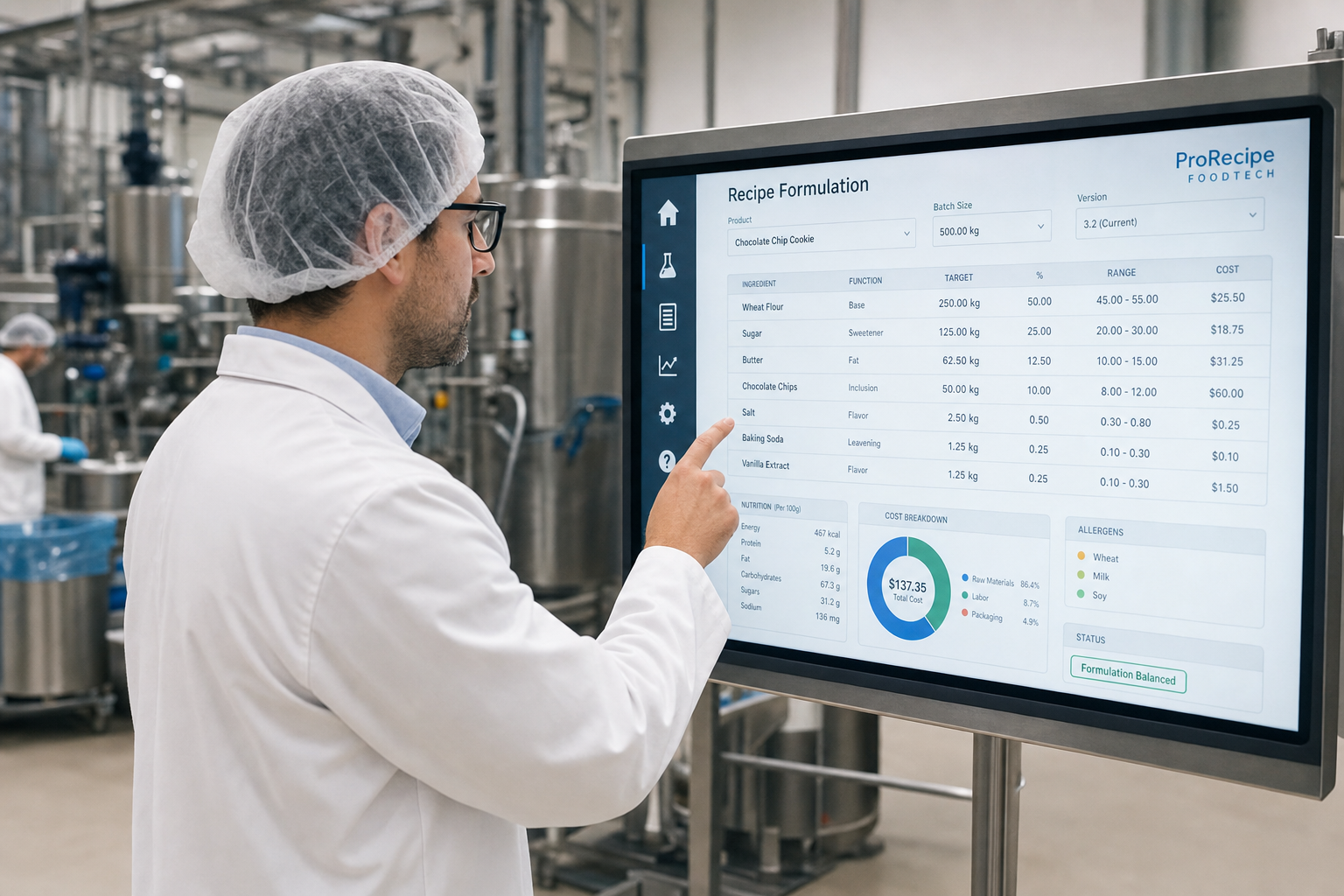
For many food producers, the journey from a kitchen startup to a growing manufacturing business begins with a spreadsheet. It holds the master recipes, the ingredient costs, the first attempts at production planning. It feels simple, flexible, and free. But as orders increase and operations scale, that trusted tool becomes a hidden liability. A single change to an ingredient ripples through costs, nutritional information, and allergen warnings. Version control becomes a nightmare of 'Recipe_Final_v2_USE_THIS_ONE.xlsx'. At scale, the spreadsheet doesn't just break; it creates significant financial and regulatory risk.
The Version Control Nightmare: When a "Small Tweak" Causes Chaos
One of the first signs that a spreadsheet-based system is failing is the loss of a single source of truth. An R&D team might develop a 'new and improved' version of a recipe, a purchasing manager might substitute a key ingredient due to supply issues, or a production manager might make a minor adjustment on the factory floor. Each change, however small, creates a new, unofficial version of the recipe. Before long, nobody is certain which version is the correct one. This leads to inconsistent product quality, unpredictable yields, and customer complaints.
Purpose-built food production software solves this by enforcing disciplined version control. In the Response365 Food Production module, every recipe has a version history with effective dates. A new version can be drafted, tested, and approved through a formal workflow before it is released to the production floor. Older versions are archived, not deleted, providing a complete audit trail. This ensures that production teams are always working from the approved, current recipe, eliminating guesswork and guaranteeing the consistency that is critical for brand reputation. When a substitution is necessary, rules can be predefined to show the immediate impact on cost and allergen profiles before the change is even committed.
Costing Blindness: The True Price of Inaccurate Recipes
In a spreadsheet, recipe costing is a static, manual exercise. You enter the purchase price of ingredients and calculate the cost per batch. But what happens when the price of flour increases by 5%, or a new supplier offers a discount on bulk cocoa? These changes are rarely updated in real-time across every recipe that uses that ingredient. The result is a growing gap between the 'standard cost' in the spreadsheet and the actual cost of production. This margin erosion can go unnoticed for months, silently eating into profitability.
An integrated system connects the recipe directly to live financial and procurement data. Response365's platform architecture means the recipe in the Manufacturing module reads data from the same database as the Purchasing and Profitability Monitor modules. When a new price is entered for a raw material lot, the standard cost of every finished good that uses it is instantly recalculated. This provides an accurate, real-time view of margins per product and per batch. Operations managers and CFOs can see the immediate financial impact of ingredient changes and make informed decisions about pricing and procurement strategy, rather than relying on outdated and inaccurate spreadsheet calculations.
Allergen Management: From Manual Checklists to Systemic Enforcement
Undeclared allergens are consistently one of the leading causes of food recalls in the UK, accounting for over half of all incidents in some studies. Under regulations like the EU's Food Information for Consumers (FIC) Regulation (EU) No 1169/2011, manufacturers are legally required to clearly declare the presence of 14 major allergens. In a spreadsheet, this relies on a human remembering to check every ingredient and update the list — a process fraught with risk. Forgetting to note that a new supplier's vegetable oil contains a soy derivative can have severe consequences for a consumer and trigger a costly recall.
Recent UK analyses suggest food recalls cost around £1 million in typical direct expenses, with many serious cases running to between £2.5 million and £5 million. Allergen-related issues are a primary driver of these events, with one study finding they caused 57.6% of recalls over a five-year period.
Modern recipe management systems remove this manual friction. Within Response365's food production software, each raw material in the Inventory Management module can be flagged with its constituent allergens. This data is inherited by any recipe that uses it. If an ingredient is substituted, the system automatically checks for changes in the allergen profile. If a new allergen is introduced, it triggers a warning and can even block the recipe's release until a formal review is completed. This creates a systemic safeguard, turning a high-risk manual task into an automated and reliable compliance check.
The Labeling Disconnect: Why Your Packaging Is Always Out of Date
The recipe is the source of truth for the product label. It dictates the ingredient list, the nutritional information, and the all-important allergen declaration. When the recipe lives in a spreadsheet and the label is designed in a separate graphics program, a dangerous disconnect is created. A last-minute change to the recipe—for example, switching from cane sugar to a glucose-fructose syrup—requires a corresponding update to the label. If this step is missed, every unit that leaves the factory is technically mislabelled, creating a major compliance risk.
An integrated platform ensures the label is never out of sync with the recipe. The Response365 Label Design module features live data bindings that pull information directly from the approved recipe master. When a recipe is updated and approved, the allergen list on the corresponding label template automatically refreshes, with allergens highlighted in bold as required by regulations. This eliminates the possibility of human error and ensures that the information on the packaging is always an exact reflection of the product inside, maintaining regulatory compliance and consumer trust.
Traceability and Recalls: From Days of Digging to Minutes of Reporting
When a supplier reports a problem with a raw material, or a customer reports an issue with a finished product, regulators expect a rapid and precise response. New frameworks like the FDA's FSMA 204 Final Rule are placing even stricter demands on traceability record-keeping. Trying to trace a specific lot of an ingredient through spreadsheet-based production logs is a slow, painful, and often inaccurate process of digging through files and matching batch numbers manually. This delay increases the scope and cost of a potential recall.
A unified system with granular lot tracking provides the foundation for instant, accurate traceability. Because Response365 uses a single database, the inventory management module maintains a complete genealogy for every item. It records which raw material lots were consumed in which production batches to create which finished good lots. This data trail flows seamlessly from goods-in to final dispatch. In the event of an incident, the Food Security module can perform a full forward-and-backward trace in seconds. It can identify every customer who received a specific batch and every other product made with the compromised ingredient lot, dramatically reducing the time and cost of a recall and demonstrating robust control to regulators.
Scaling Production: Beyond the Recipe to the Process
A recipe is more than just a list of ingredients and quantities; it is a series of steps and processes. Each step may have specific instructions, quality control checks, or designated HACCP Critical Control Points (CCPs). A spreadsheet can list these steps, but it cannot enforce them. It cannot ensure a temperature was checked and recorded, that a cleaning procedure was completed before an allergen-free run, or that an operator signed off on a critical quality check. This lack of process control is a major source of inconsistency and risk as production volumes grow.
This is where the concept of the recipe evolves into an Electronic Batch Record (EBR). Within the Response365 Food Production module, recipes are built as a sequence of operations. Each operation can have embedded work instructions, quality plans, and data capture fields. On the factory floor, operators are guided through the process on a tablet, and must electronically sign off on each step before proceeding. This creates an immutable, time-stamped record of every action taken for every batch, conforming to the principles of frameworks like FDA 21 CFR Part 11. It transforms the recipe from a static document into a dynamic, enforceable workflow, ensuring that the product is not only made with the right ingredients, but is made the right way, every single time.
Food Production on Response365
Response365 provides a unified platform where recipe management is integrated with inventory, quality, compliance, and finance. Manage version-controlled recipes with effective dates, automatically calculate cost and allergen impacts, enforce production steps with Electronic Batch Records, and generate compliant labels from a single source of truth. Ensure full lot traceability from raw material to finished good for rapid, precise recalls.