

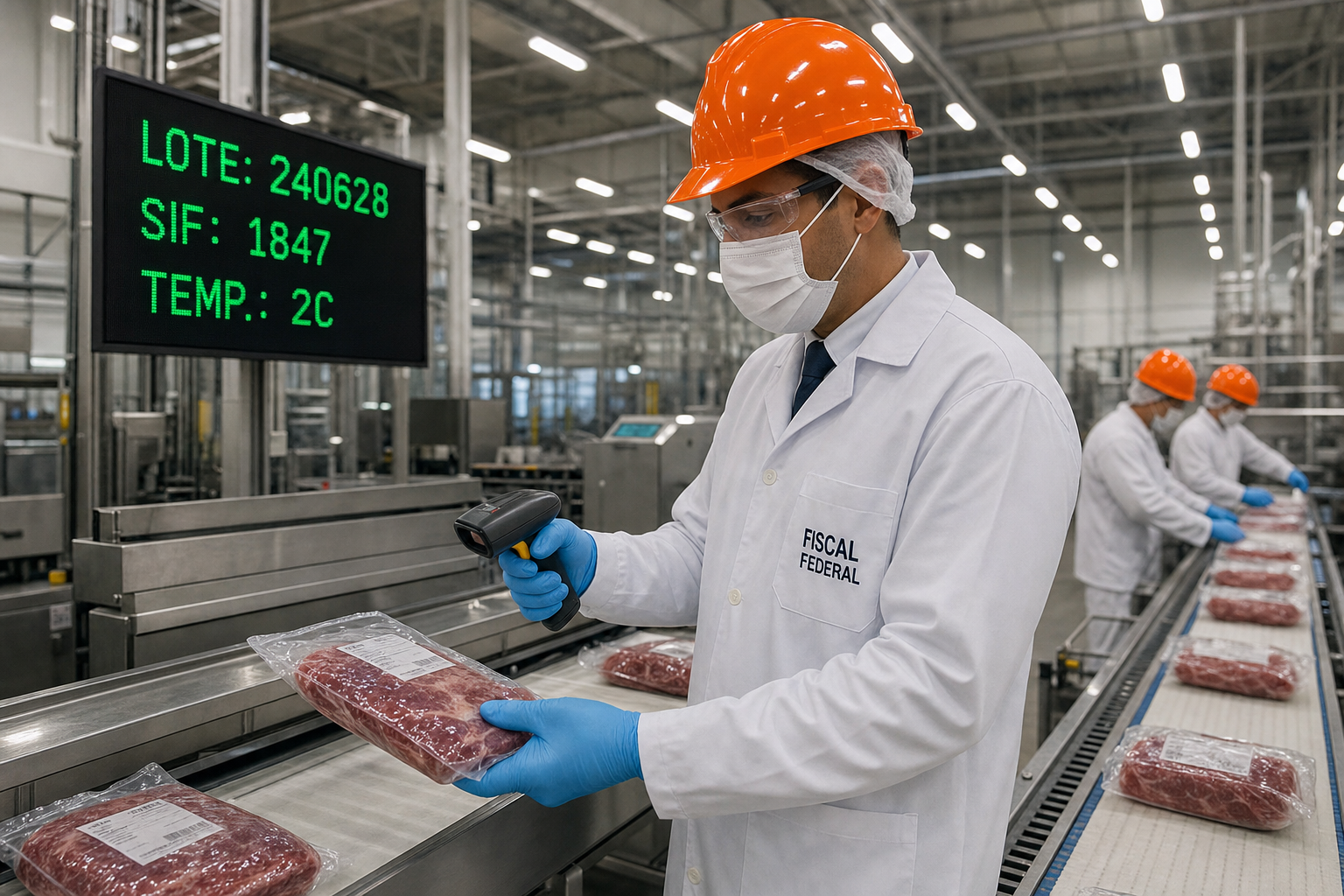
Brazil occupies a singular position in global food trade. It is the world's largest net exporter of beef, poultry, sugar, soybeans and orange juice — a position built on scale, biological productivity and three decades of food production infrastructure investment. But the compliance framework governing what a food manufacturer can produce, label and ship from Brazilian territory is unusually complex. Three distinct regulatory pillars — MAPA, SIF and ANVISA — govern separate dimensions of the same product, and all three must be satisfied before a single pallet can legally move. For companies entering or scaling in the Mercosur market, understanding this triad is not background knowledge; it is a prerequisite for operational continuity.
Two Ministries, One Product
Brazil's food regulation is distributed across two government bodies with different mandates and enforcement mechanisms. The Ministério da Agricultura, Pecuária e Abastecimento (MAPA) governs the safety and inspection of products of animal and plant origin, with a particular emphasis on export certification. MAPA operates the Serviço de Inspeção Federal (SIF), the federal inspection service that registers establishments and certifies individual export consignments. Alongside MAPA, ANVISA — the Agência Nacional de Vigilância Sanitária — regulates food labelling, additive declarations, contaminant limits and the public health dimension of food safety across all categories, animal-origin or not.
A single product — a shelf-stable beef broth, for instance — requires both a registered SIF establishment number (because it derives from animal origin) and ANVISA compliance for its front-of-pack warning system, allergen declaration and nutritional table. These are not sequential steps. The MAPA inspection schedule and the ANVISA labelling regime run in parallel, governed by different legislation, with different documentation requirements and different consequence structures for non-conformance. A food regulatory framework built for a single-regulator market — the EU's EFSA structure, for example — will systematically misrepresent the Brazilian compliance posture and generate gaps that MAPA or ANVISA inspectors will find.
The SIF Number: Gateway to Animal-Derived Markets
The SIF number is the most consequential compliance identifier for Brazilian food producers working with animal-origin materials. Issued by MAPA under the RIISPOA (Regulamento da Inspeção Industrial e Sanitária de Produtos de Origem Animal), the SIF number appears on every package, label and export document for meat, poultry, dairy, eggs and fish products from a registered establishment. Without it, no product of animal origin can legally enter interstate commerce in Brazil — and export is impossible.
Obtaining and maintaining SIF registration is an ongoing compliance obligation, not a one-time administrative step. Federal inspectors are permanently stationed in larger establishments. The SIF number can be suspended following a non-conformance finding, which immediately blocks all interstate movement and export activity. Every MAPA export sanitary certificate references the establishment's SIF number explicitly. A production batch that cannot be traced to its SIF-registered establishment cannot be exported, regardless of how compliant its labelling or recipe might be. Batch traceability in the production system must link unambiguously from incoming raw material lot to outgoing shipment — and that link must be retrievable within hours during an inspection or recall event, not days.
ANVISA's Labelling Revolution: RDC 429 and RDC 727
Two ANVISA resolutions fundamentally changed the economics of food labelling in Brazil. RDC 429/2020 introduced mandatory front-of-pack nutritional labelling — a high-contrast magnifying-glass warning icon on the front of any food or beverage exceeding threshold levels of added sugars, sodium or saturated fat. RDC 727/2022 updated the back-of-pack nutrition table, requiring values per 100g (or per 100ml for liquids) and per serving simultaneously, with revised reference serving sizes and an updated mandatory allergen declaration list covering 14 declarable allergen classes.
The combined effect is that every processed food sold in Brazil now requires a label that is regime-specific: it cannot be adapted from a European or North American equivalent without structural changes. The front-of-pack warning system, the allergen declaration format and the nutrition table layout are all distinct from EU 1169/2011, from FSANZ labelling rules and from FDA 21 CFR Part 101. For a company producing variants for Brazil, Argentina, Uruguay, the EU and the US simultaneously, each label version must be maintained under version control, tied to the specific recipe version it describes, and updated when recipe changes cross ANVISA thresholds. Without automated recipe-to-label traceability, a reformulation that takes a product above an ANVISA warning threshold will generate non-compliant product in the market before the labelling team catches it.
The front-of-pack warning icon introduced by ANVISA RDC 429/2020 is not a design choice — it is a mandatory legal requirement tied to specific nutrient thresholds. A label that is fully compliant for the EU or the US will almost certainly be non-compliant for Brazil.
The Mercosur Layer: GMC Resolutions and Intra-Block Trade
Brazil is a founding member of Mercosur (MERCOSUL in Portuguese), the Southern Common Market that also includes Argentina, Uruguay and Paraguay. Mercosur food standards are issued as GMC (Grupo Mercado Comum) resolutions, harmonising rules across the bloc for food additives, contaminant limits, labelling requirements and maximum pesticide residue levels. For Brazilian food manufacturers, GMC resolutions do not replace MAPA or ANVISA requirements — they layer on top of them, applying specifically when product is sold or shipped to other Mercosur member states.
For intra-block sales, Mercosur Certificates of Origin establish that a product's NCM (Nomenclatura Comum do Mercosul) code, its substantial transformation in Brazil, and its compliance with Mercosur rules of origin entitle it to preferential tariff treatment under the Tarifa Externa Comum (TEC). The NCM code — Mercosur's version of the Harmonised System tariff classification — must be assigned correctly at product creation. An incorrect NCM code propagates through every downstream document: the NF-e, the SISCOMEX export declaration and the certificate of origin. Correcting an NCM error after a shipment has been issued is an administrative process that can hold a consignment for days.
NF-e and NCM: When Tax Law Reaches the Production Floor
The Nota Fiscal Eletrônica (NF-e) is Brazil's mandatory electronic invoice, required for virtually every commercial movement of goods — not just sales, but inter-plant transfers, raw material receipts, returns and intra-company movements. In a food production environment, every raw material intake, every intra-plant material transfer, every finished goods movement to a distribution warehouse and every outbound dispatch generates an NF-e that must be authorised in real time by the relevant state SEFAZ.
Each NF-e must carry the NCM code of every product line item, the CFOP (Código Fiscal de Operações e Prestações) classifying the operation type, and the applicable tax rates for ICMS, PIS, COFINS and IPI. In food production, many of these rates vary by product category, origin and destination state, and may carry exemptions for certain primary agricultural inputs. This means the production floor and the fiscal compliance system are tightly coupled in a way that has no equivalent in European or North American manufacturing contexts. A system that runs batch records separately from inventory movements, and inventory movements separately from fiscal emission, will accumulate NF-e inconsistencies that translate into SEFAZ audit exposure over months of operation.
SISBOV: Bovine Traceability and Export Eligibility
Brazil produces and exports more beef than any other country. The Sistema Brasileiro de Identificação e Certificação de Bovinos e Bubalinos (SISBOV) is the national traceability system administered by MAPA, under which individual animals are tagged, registered and tracked from birth through all movements to slaughter. SISBOV records are a prerequisite for beef export to markets — notably the EU — that require lot-level traceability back to the animal of origin.
For a compliant production operation, SISBOV data must flow into the production system at the point of raw material receiving. Each beef lot received must carry its SISBOV reference, and that reference must link forward through processing, packaging and QA release to the outbound shipment. The MAPA export sanitary certificate for EU-destined beef explicitly references the SISBOV records of the animals in the lot. If this chain is broken — because receiving and production run in different systems — the documentation cannot be assembled under audit pressure, and the export certificate cannot be issued. For companies scaling their food security and traceability compliance, this single integration point is often where generic ERPs fail first.
The Export Document Cascade to EU and US Markets
A Brazilian food company exporting beef, dairy or processed food to the EU or the US generates a document cascade that begins at the production batch level and must be complete before customs clearance at the destination. For EU-destined animal products, the sequence involves:
- MAPA export sanitary certificate referencing the SIF establishment number and the product lot
- ANVISA-compliant destination label variant (regime-specific nutrition table and allergen format)
- Mercosur Certificate of Origin where the MERCOSUR↔EU preferential tariff applies
- NF-e for the export movement with the correct NCM and CFOP codes
- SISCOMEX export declaration referencing the NF-e and the sanitary certificate
- Cold-chain and veterinary transport documentation where applicable
For US-destined products, an additional FDA Prior Notice of Imported Food Shipment is required, and for meat products an FSIS import inspection request must accompany the MAPA certificate. The MERCOSUR↔EU trade agreement, currently in the final stages of ratification, will add a preferential tariff certificate with its own rules-of-origin verification requirement once fully in force. Each document in this cascade draws from production batch data, product master data (NCM code, ANVISA registration, SIF establishment number) and shipment data — all of which typically reside in separate systems in most mid-market Brazilian food companies.
Why Generic ERP Systems Fail Brazilian Food Producers
The compliance requirements described above are not specialist concerns for exporters. They are baseline requirements for any food manufacturer of meaningful scale operating in Brazil. Yet the most common ERP architecture in mid-market Brazilian food companies involves separate systems for production batch management, fiscal emission (NF-e and SEFAZ integration), inventory management and trade compliance documentation. Data moves between these systems manually, or via fragile flat-file integrations that break silently.
The failure modes are predictable: NF-e issued with the wrong NCM because the fiscal system's product master is out of sync with the production master; batch records that cannot link to the SIF certificate because production and export documentation are in separate tools; ANVISA labelling versions that drift from the current recipe because label design lives in a standalone application; SISBOV records that cannot be retrieved under audit pressure because receiving data and production data are siloed. Each failure is an audit exposure event. When a MAPA inspector arrives or a SEFAZ query covers six months of NF-e activity, the documentation must be complete and internally consistent from raw material intake to outbound shipment.
The alternative is a platform where the product master record carries the SIF establishment number, the NCM code, the ANVISA registration status and the SISBOV reference as native fields; where every batch record automatically links to its SIF and SISBOV data; where NF-e emission draws from real-time inventory movements rather than a separate fiscal system; and where label versions are locked to recipe versions. This eliminates the coordination overhead and closes the error surface at source — rather than managing the consequences of disconnection after the fact.
Food Production for Brazil and Mercosur Markets
Response365 Food Production carries MAPA/SIF establishment numbers, NCM codes, ANVISA labelling versions and SISBOV references as native product master fields. Every batch record links to its SIF certificate, every NF-e is generated from real inventory movements, and bovine traceability runs from raw material receiving to the MAPA export sanitary certificate — all in a single unified database shared with Inventory, Warehouse, Global Trade Compliance and Finance.